


 |
| A migrant worker on a special train headed to Agra from Sabarmati Railway Station amid the Corona-19 lockdown. Sam Panthaky/AFP https://scroll.in/article/960909/why-is-india-spending-money-showering-petals-on-hospitals-but-making-workers-pay-for-train-tickets Image by Sam Panthaky/AFP from the article at link above
It is staggering that a State which talks highfalutin ideals cannot do right by its poorest citizens in getting them home under the rigors of the pandemic without squeezing their pockets. What is it about us Indians where we are loathe to regard the less fortunate, those who labor in hard and trying circumstances, or are victims of their birth and other extenuating circumstances.
This article in scroll.in reminded me of brought to mind the mindset of someone from my school, who recently said in an online group; and I paraphrase: that he believes everything should be earned, that nothing is for free or ought to be, to emphatically mean, no free lunch. Its pains them to see any form of institutional welfare, other than of course crumbs in exceedingly dire situations. But they are the beneficiaries of State socialism. No logic to their madness and cruelty. Always falling prey to their brazen elan of hatred fueled with righteous bravado. And, these are serial zealots who prey on the weak but are ostensibly attuned to godliness! Its high time to reflect more on such hypocrisies. |
Sunday, May 3, 2020
May the meek inherit something


Thursday, April 23, 2020
The New Old Fire :: Жаңа Ескі Алау :: El Fuego Viejo Nuevo

The New Old Fire :: Жаңа Ескі Алау :: El Fuego Viejo Nuevo
I appreciate it when somebody notices one of my works from the past, Here it was Martha Rodriguez. In my early works I was essentially gambling while developing an understanding the variables of creating in my own little way. Those being ideation, color, color across mediums, flows, layering; viscocities, of water, milk, honey, spittle, etc.,; the practiced ability to draw directly with paint, loosely in pencil, or not at all. A lot about how I approach paper is now "organic" or natural, and the newer works reflect the conglomeration of various forces and disciplines. I am unashamed to say that earlier and understandable fears have left me. I was not trained at all in painting, and barely in illustration. More coming in small essays on my blog, Venantiusaneum.

Agradezco cuando alguien nota uno de mis trabajos del pasado, aquí fue Martha Rodríguez. En mis primeros trabajos, esencialmente estaba jugando mientras desarrollaba una comprensión de las variables de creación a mi manera. Los que son ideación, color, color a través de medios, flujos, capas; viscosidades de agua, leche, miel, saliva, etc. la habilidad practicada para dibujar directamente con pintura, sin apretar a lápiz, o nada en absoluto. Mucho sobre cómo abordo el papel ahora es "orgánico" o natural, y los trabajos más nuevos reflejan el conglomerado de varias fuerzas y disciplinas. No me avergüenzo de decir que los temores anteriores y comprensibles me han dejado. No estaba entrenado en pintura, y apenas en ilustración. Más en pequeños ensayos en mi blog, Venantiusaneum
PS: I recently have learnt that this blog of uses cookies. Please NOTE.
Tuesday, September 11, 2018
A cover for the Naugatuck River Review
To engage with thoughts, and those of others
a larger consciousness. Sympathetic space.
The why of things, occurrences, stirrings, evocations,
the space between one's legs, a visage, the tilt of a head,
Spaces that certain people simply seem to inhabit.
 Naugatuck River Review, a journal of narrative poetry. Summer/Fall, 2018 - Issue 20. ISSN: 1944-0952
Publisher/Managing Editor: Lori Desrosiers
Associate Editor: Michael Mercurio
Guest Editors: Tamra Callaher. Howie Faerstein, Anita Gallers, Robbie Gamble, Ellen LaFleche
+
Cover Artists Statement
Venantius J Pinto, a graduate of Pratt Institute, is a 7th Dan in Shodō. An artistic laborer of Indian descent; born of Goan parentage, he grew up among many religiosities in India; and lives in New York City seeking for possibilities into phenomena that pass within his senses. From 1992–97, he was an Adjunct Professor at FIT, and was gainfully employed at OgilvyOne and later at DDB. Over the years he has maintained his freelance practice.
His art has appeared in the Kyoto Journal, Philosophy Now, two academic books, showcased in An Illustrated Life, on the covers of Pirene’s Journal, and Canon for Bears and Ponderosa Pines; in Fusor de Tintas: A century of combat poetry, Mexico. Aani and the Tree Huggers was on the Smithsonian magazine’s Most Notable Book List. He was Artist-in-Residence at Nagasawa Art Park Japanese Woodblock Printmaking in Awajishima, and has painted murals including in 2017 in Argentina, Colombia and Mexico. He has collaborated with Sondra Graff on projects for various dance companies, including Lucinda Childs, Jose Limon, Doug Varone and Dancers, Dance Brazil, and for The British Dance Invasion.
To engage with thoughts, and those of others
a larger consciousness. Sympathetic space.
The why of things, occurrences, stirrings, evocations,
the space between one's legs, a visage, the tilt of a head,
Spaces that certain people simply seem to inhabit.
Since early childhood, I was drawn to color, detail in objects, faces, and things that projected unique lines; realizing that lines convey movement which in turn express what even the senses may not register. Looking into the spirit of language and the spirit in color is a critical part of the process, whether by seeking depth in a proverb or being touched by color resonances. Ethics more than aesthetics concerns the primary focus. The aesthetics fall into place once I am sufficiently propelled to act on form.
In that sense my concerns are phenomenological: This concern perhaps stems from a desire to give meaning to differences in my existence compared to that of another person.
Line and marks define, convey momentum;
Delineate space, pierce space, radiate space, sensibilize space.
They hatch texture, layer tone
Split the curtain, raise up storms;
Approach as tsunamis, create Upheaval;
Give hopes their horizons
Convey sensibility.
venantius.pinto@gmail.com
a larger consciousness. Sympathetic space.
The why of things, occurrences, stirrings, evocations,
the space between one's legs, a visage, the tilt of a head,
Spaces that certain people simply seem to inhabit.

Publisher/Managing Editor: Lori Desrosiers
Associate Editor: Michael Mercurio
Guest Editors: Tamra Callaher. Howie Faerstein, Anita Gallers, Robbie Gamble, Ellen LaFleche
+
Cover Artists Statement
Venantius J Pinto, a graduate of Pratt Institute, is a 7th Dan in Shodō. An artistic laborer of Indian descent; born of Goan parentage, he grew up among many religiosities in India; and lives in New York City seeking for possibilities into phenomena that pass within his senses. From 1992–97, he was an Adjunct Professor at FIT, and was gainfully employed at OgilvyOne and later at DDB. Over the years he has maintained his freelance practice.
His art has appeared in the Kyoto Journal, Philosophy Now, two academic books, showcased in An Illustrated Life, on the covers of Pirene’s Journal, and Canon for Bears and Ponderosa Pines; in Fusor de Tintas: A century of combat poetry, Mexico. Aani and the Tree Huggers was on the Smithsonian magazine’s Most Notable Book List. He was Artist-in-Residence at Nagasawa Art Park Japanese Woodblock Printmaking in Awajishima, and has painted murals including in 2017 in Argentina, Colombia and Mexico. He has collaborated with Sondra Graff on projects for various dance companies, including Lucinda Childs, Jose Limon, Doug Varone and Dancers, Dance Brazil, and for The British Dance Invasion.
To engage with thoughts, and those of others
a larger consciousness. Sympathetic space.
The why of things, occurrences, stirrings, evocations,
the space between one's legs, a visage, the tilt of a head,
Spaces that certain people simply seem to inhabit.
Since early childhood, I was drawn to color, detail in objects, faces, and things that projected unique lines; realizing that lines convey movement which in turn express what even the senses may not register. Looking into the spirit of language and the spirit in color is a critical part of the process, whether by seeking depth in a proverb or being touched by color resonances. Ethics more than aesthetics concerns the primary focus. The aesthetics fall into place once I am sufficiently propelled to act on form.
In that sense my concerns are phenomenological: This concern perhaps stems from a desire to give meaning to differences in my existence compared to that of another person.
Line and marks define, convey momentum;
Delineate space, pierce space, radiate space, sensibilize space.
They hatch texture, layer tone
Split the curtain, raise up storms;
Approach as tsunamis, create Upheaval;
Give hopes their horizons
Convey sensibility.
venantius.pinto@gmail.com
Sunday, July 8, 2018
Katelyn Franklin's, Horsy Land
When I was in first grade in India, I won a book on horses for standing First in class. That book in 1967 (if I am not mistaken) introduced me to all kinds of horses, including the Pintos, Piebalds, Shetland ponies, Morgans, the Clydesdales, the Arabians, the Palominos, the Lippizanners, and other splendid breeds.
This post incidentally is to celebrate the site Horsy Land which is maintained by Katelyn Franklin of Brooklyn. It introduces one to horse training and various breeds while elucidating succinctly what is special about a given horse.
As a child I was impressed with the picture of the Morgan in my book, but also because of my mother's cousin, was named Morgan! Few of us were aware of where names came from and how they were assigned. For instance, my mother picked my name Venantius from the Salesian calender. So from reading about the Morgan horse provided this information under What Makes a Morgan Horse so Special?

photo: Horsy Land, Kathelyb Franklin
This post incidentally is to celebrate the site Horsy Land which is maintained by Katelyn Franklin of Brooklyn. It introduces one to horse training and various breeds while elucidating succinctly what is special about a given horse.
As a child I was impressed with the picture of the Morgan in my book, but also because of my mother's cousin, was named Morgan! Few of us were aware of where names came from and how they were assigned. For instance, my mother picked my name Venantius from the Salesian calender. So from reading about the Morgan horse provided this information under What Makes a Morgan Horse so Special?

photo: Horsy Land, Kathelyb Franklin
The Morgan horse has been known as the first family of American horses. The early development of the breed took place in the New England states...And that too after almost 51 years. Of course, there was no good reason to look it up, as with so many things encountered in childhood; and besides, we did not have an encyclopedia at home. And further:
Legend has it that, one evening during the Revolutionary War, Colonel De Lancey, commander of a Tory mounted regiment, rode up to an inn at King’s Bridge and after hitching his famous stallion, True Briton, to the rail, went into the inn for some liquid refreshments, as was his custom. While the Colonel was celebrating with liquor and song, the Yankees stole his horse, later selling the animal to a farmer near Hartford, Connecticut. The whimsical story goes on to say that True Briton later sired the fuzzy-haired colt that was to be christened after his second owner, Justin Morgan.
I plan on visiting the Horsy Land site and am looking forward to the possibility of drawing horses when I get/have the opportunity to do so.
Thursday, February 15, 2018
Ode to a Fragment of
Silence is my depiction of my father Bernard Pinto's
final journey and reads from right to left. This drawn narrative is a
reenactment, a walking, from a place which at that time I still called home —
to the cemetery. The narration being a recital of the funereal events drawn to
reflect my voice, the lines emanating as marks upon reflection on photographs;
and most emphatically a narratology of my fathers voice coming to me as
fragments. Memory traces, fragmentations, lines, blots, pressure, the spirit of
the moments shared giving form, a trace, transparency, lucidity — some meaning.
The moments of drawing, moments within drawing, fragments, stylistic or
otherwise. But what really led me to the paper? Rothko in an address to Pratt
Institute in November 1958 emphatically spelled out the idea that one must look
beyond the concern for self-expression towards seeking ingredients such as
having a “clear preoccupation with death — intimation of mortality … Tragic
art, romantic art, etc… deals with
Saturday, February 10, 2018

चिTo draw whatever, become that. I believe deeply in such an emotive transformation. In becoming one with the ones, you reach towards a becoming one with the other and in the One. This project tapped my narrative compositional ability at a point when Here is a project that give a small glimpse of what I can do.
Become one with bears and pines, and …! In becoming one with the ones (elements in visual narratives), you reach towards a becoming one with the other (collaborator) and in the One.
In desiring oneness with the ones (elements) you reach towards being one with the other (a collaborator), moving towards the One.
Canon for Bears and Ponderosa Pines “In this new and startling collection, Diane Frank’s poems transcend not just genres but entire dimensions. When she speaks to J.S. Bach, she really means it and when Bach speaks back, she listens — entirely — the way certain moths perceive sound via their whole body, even their wings. How is this accomplished? It will seem to come through the poems themselves — their music, tonal qualities and subjects, yet it goes even deeper as it pushes up like duende through the soles of your feet. The voice is declarative, emphatic, spirit driven. She will tell you, ‘When a buffalo enters your dream, / listen for arpeggio hooves, / the weight of music, / a copper moon / above a vanishing prairie’ and you will, you must listen.” —Lois P. Jones, author of Night Ladder, Radio Host, KPFK’s Poets Café
Is!

Recently, in response to an interest in my art I could barely remember my artistic labor having a Christian component! What happened? Realized now, that I see what I do as catholic — universal. Liberal in embrace and acceptance, not the liberal connotation du jour. I see myself as a Hindu Christian. So Christ crucified on a banyan tree with a baby monkey keeping anguished watch is equally or more relevant to non-Christians. True, it will be seen as Christian, steeped as it is in its realization and rootedness in faith, although it never occurred to me that it was singularly Christian art. In the broadest sense which frighteningly envelope everything, I reflect on ideas at the intersection of religion, sexuality and consciousness. In standing at the crossroads I see as suggested in Jeremiah 6:16: Thus saith the Lord, Stand ye in the ways, and see, and ask for the old paths, where is the good way, and walk therein — conduits towards comprehension from various quarters. That is my reading.
Monday, January 8, 2018
Watching shadows from within the shadows_PICK
On pickpockets.
As a child, I was gentle and respectful of elders who to my eyes was every person who had that demeanor of being in charge. It was later, way into my forties that the realized that this quality was a developmental excess which in the ensuing years had morphed into other
aberrations that affects emotions ones view of others.
My father encouraged and helped me board the train. I was timorous timid child and secured a place in the crowded VT Local. The overhead train light hardly shed any illumination below the commuters necks, shouldering their burdens. Those furrowed face lined with
I noticed a hand reached from the effulgent inkiness as though it was some hand-headed creature; but catching the fierce eyes of the thief--the alarm stayed stuck in my throat. Overcome and lost. Father was very reasonable and did his best to get me to give up the fear which had suffused me. This terror, and the dread that followed became companions.
Shadowing women
The creak of the bed, on which numerous hopes of a transitory release — a
small taste of moksha, a fleeting transcendence from the body, achieved in
the flesh. INTRA. Of aching pudendas stretching shadows to receive the rare beloved
in many non-encounters. A beloved who belonged elsewhere, to someone else.
Is this possible?
Carting Fetuses to gain some paisa
The
Dusk and dusky
There is nothing like
The seventh
http://www.mizukan.org/shodo.htm
India ink.
Sauli, saulent.
The spirit is the compelling force from within that exudes to the outside.
In one who settles or walks seeking a spiritual path, or regards a chosen
path as being a course of action for ones spirituality—the spirit will
manifest itself, although it does not simply materialize; nor does it show
up to make the notion any more real. The notion has to be one of surrender,
acceptance, a commitment.
What is Shodo. Boku-ju, Line, pressure, balance, form, Positive an
dnegative. What prompts.
Rinsho, Kana and Tenkoku.
Rinsho develops intuition, awareness,
Kana, in mixed form called Chowatai is when in the same piece one write in
Kanji and kana (hiragana)
Isha devata. Gram Devata. Tapping and making intuition.
http://pages.prodigy.net/david_wolfe/pmaa/Japanese_terms_S.html
Most of what we do is for ourselves. It could be our personal practices as
in a Way which we practice. In time we begin to see, or must hope to see our
practices as larger than ourselves, yet nothing more nor less than what we
thought at first. When our eyes set themselves on something beautiful the
muscles essentially relax although they pulse. All it movement. When and if
we see the sublime, our body tautens, the sight evokes awe and fear, even if
be a tinge of facing the unknown. In both these situations, or if one was
blessed by such experiences the solitary would perhaps stay in equanimity.
One cannot decide to be so. Ones being has become such or has to become
such. To stay in equanimity is to stare at what time places in front of us,
what it subjects us to. Not stare as in gawk, but stare as in commune, in
realizing that you are a part of infinitude, and are ready to accept the
charge handed to you, even if that means knowing that ones time will cease,
and yet not cease. One may be a long way off from realizing this, but its is
in our bones. My purpose is to hold hands, and in the rare case to break
bonds, although I shy from the latter.
We are, “a by-product,” as a good friend of mine says “of a lot of
productivity”—of productive energy on the part of many others. The spirit is
the shield and pointing towards salvation. This may come across as a very
Semitic notion. I see it a little differently; as available to all. We must
commit ourselves. Not to die, but an acceptance to what lies ahead and
around; so in that sense committing to death. Much like being in the center
of centers. You are not seeking death, but seeking your nature. Looking for who
you are. Being one with the light as it shines upon you, as it awakens you,
as it awakens us to sensitivities, in awareness.
www.flickr.com/photos/venantius/sets
“Dear Venantius J,
Thank you for submitting your work to Illustration Daily. The editorial board has decided to publish your illustration and it is now on the website.”
WOOT! Lord, you do have a plan for me don’t you? ¡WOOT! Señor, tienes un plan para mí, ¿verdad?

Thank you for submitting your work to Illustration Daily. The editorial board has decided to publish your illustration and it is now on the website.”
WOOT! Lord, you do have a plan for me don’t you? ¡WOOT! Señor, tienes un plan para mí, ¿verdad?

Monday, September 4, 2017
Dioses EHECATZINTTI (Ehécatl) y VAYU (Vāta, Pavana, Prāṇa)

Looking forward to an encounter of encounters in November, with the community of Ecatzingo, and those of Nahua ancestry together with God Ehecatzintti (Ehécatl)[1], and I, showing up with God Vayu[2], the deified name in India for the phenomenon that is wind (ergo, God of the Winds); to meld thoughts and ideas. Of course, as always, my Fathers will stand with me in benign attendance. I could not do it any other way. Now, what if the other wind deities decide to show up?
[1] from the air
[2] “Vāta, Pavana (“the Purifier”), sometimes Prāṇa (the breath)”
Esperando un encuentro de encuentros en noviembre, con la comunidad de Ecatzingo, y los de ascendencia Nahua junto con Dios Ehecatzintti (Ehécatl) [1], y yo, trayendo a Dios Vayu [2], el nombre deificado para el fenómeno que es el viento (por lo tanto, Dios de los vientos), mezclará pensamientos e ideas. Por supuesto, como siempre, mis Padres estarán conmigo en asistencia benigna. No podría hacerlo de otra manera. Ahora, ¿qué pasa si las otras deidades del viento deciden aparecer?
[1] desde el aire
[2] “Vāta, Pavana (“ el Purificador ”), a veces Prāṇa (la respiración)”
Friday, December 30, 2016
Todo es gracia :: All is grace

Life puts us in peculiar situations, and boy, does one learn or what? And one learns to takes charge, something that I have been averse to doing, on other turfs. So, before we slip into 2017, I’d like to put this thought out of my mind!

First of all, my appreciation goes out to Jesús Rodriguez Arevalo for initiating my nascent journey into painting murals and that too in Mexico, and also to our mutual friend Marco Patiño (of Puerta Niebla, Mineral, and Pachuca) for being a good conduit. Moving on, when I was painting my first mural at the UAEH campus in Actopan — it was sad hearing somebody say that I was a designer, and how could I possibly paint a mural. On what basis had I been invited! And besides, I did not speak Spanish, which was true. Here Marco Antonio Hernandez was an immense help, in valiantly translating for me. As was Yolanda Alamilla.

But still, it was sad, considering that I had taken on a huge reality, in fact negotiated (in my feeble Spanish) the entire huge wall (there was nothing insane about doing so) instead of the quarter part we have been allocated; besides, it should have been immediately apparent that Paulina Genea, and I were doing a good job — despite my inability to converse with her in Spanish; it being my first mural; working eventually off of a ladder while holding paints, and brushes at a height of about 25 plus feet. Truth be told, there was no equipment for such a large surface, Yet, resolving problems with the able assistance of Alecs Gómez (when he was available). But we came through, and no one has said anything more. On another note, one of my NY friends, a Japanese bloke who later said: Venantius, it was a collaboration in parts!

I went to the next encounter, to square things off, to give back, to be out of debt. And I appreciated the opportunity. I pushed it a couple of notches higher on both sites (Biblioteca de Actopan, and in Col. Morelos), something I could have done the first time around. Patience, and time. Time will tell.

Recently, on my third encounter, I pretty much stayed in my corner at the end of town in Col. Morelos. And it was quite blissful. I think I missed most of the activities, because I forgot that I have been handed a piece of paper by Juan Manuel Ruiz with the scheduled activities. It was a blessing that I was pretty much forgotten. No one came for me. I finished in good form, considering I had started very late on the murals, and having to deal with other logistical issues. All is grace.


La vida nos pone en situaciones peculiares, y muchacho, ¿uno aprende o qué? Y uno aprende a tomar la carga, algo que he sido aversión a hacer, en otros céspedes. Así que, antes de entrar en 2017, me gustaría poner este pensamiento fuera de mi mente!
En primer lugar, mi agradecimiento a Jesús Rodríguez Arévalo por iniciar mi incipiente viaje en murales de pintura y también en México, y también a nuestro amigo común Marco Patiño por ser un buen conducto. Continuando, cuando estaba pintando mi primer mural en el campus de UAEH en Actopan - fue triste oír a alguien decir que yo era un diseñador, y cómo podría yo posiblemente pintar un mural. ¡Sobre qué base me habían invitado! Y además, yo no hablaba español, lo cual era cierto. Aquí Marco Antonio Hernández fue una inmensa ayuda, en valiente traducción para mí. Al igual que Yolanda Alamilla.

Pero aún así, era triste, teniendo en cuenta que había tomado una enorme realidad, de hecho negociado (en mi débil español) todo el enorme muro (no había nada insano en hacerlo) en lugar de la cuarta parte que hemos sido asignados; Además, debería haber sido inmediatamente evidente que Paulina Genea, y yo estábamos haciendo un buen trabajo — a pesar de mi incapacidad para conversar con ella en español, Siendo mi primer mural; Trabajando eventualmente fuera de una escalera mientras sostiene pinturas y cepillos a una altura de unos 25 pies más. A decir verdad, no había equipo para una superficie tan grande, Sin embargo, la resolución de problemas con la ayuda capaz de Alecs Gómez (cuando estaba disponible). Pero llegamos, y nadie ha dicho nada más. En otra nota, uno de mis amigos de Nueva York, un tipo japonés que más tarde dijo: Venantius, fue una colaboración en partes!

Fui al siguiente encuentro, para cuadrar las cosas, para devolver, para estar fuera de la deuda. Y aprecié la oportunidad. Lo empujé un par de muescas más alto en ambos sitios (Biblioteca de Actopan, y en Col. Morelos), algo que podría haber hecho la primera vez. Paciencia y tiempo. El tiempo dirá.

Recientemente, en mi tercer encuentro, casi me quedé en mi esquina al final de la ciudad en Col. Morelos. Y fue muy feliz. Creo que me perdí la mayoría de las actividades, porque olvidé que me han entregado un pedazo de papel de Juan Manuel Ruiz con las actividades programadas. Fue una bendición que me olvidaran. Nadie vino por mí. Terminé en buena forma, teniendo en cuenta que había empezado muy tarde en los murales, y tener que lidiar con otros problemas logísticos. Todo es gracia.
Friday, June 24, 2016
Thursday, June 23, 2016
Monday, May 16, 2016
Wednesday, May 6, 2015
Henry David Thoreau
May 6, 2015 is the 153nd death anniversary of Henry David Thoreau. (July 12, 1817 - May 6, 1862). Walden, A Week on the Concord and Merrimack Rivers, Cape Cod, The Allegash and East Branch, Walking, Civil Disobedience, Slavery in Massachusetts, A Plea for Captain John Brown, Life Without Principle.
खुशालकाय अनिक संतुष्टतायेंन भरपूर अशीं नव्या वर्साचीं परबीं आंवड़ेतां, बाब वेनि !
वोय खुशालकायेंत अनि मॉईपासांत ऐकमेकाकं ऑलकोया
खुशालकाय अनिक संतुष्टतायेंन भरपूर अशीं नव्या वर्साचीं परबीं आंवड़ेतां, बाब वेनि !
वोय खुशालकायेंत अनि मॉईपासांत ऐकमेकाकं ऑलकोया
Sunday, February 8, 2015
Monday, November 17, 2014
Conjuncts
http://www.devipaduka.com/formsandpublications/Sanskrit--Module-01-V10-final.pdf
तुमचा दोन मुर्कांचा उदाहरण खरा आहे पण शिकणाऱ्याना माहिती पुष्कल आणि वेगळ्या वेगळ्या रस्त्याने घेता येते। फक्त इच्छा असावी। अदुनिक्ता आमच्या समोहर उभी आहे। ज्यांच्या कड़े जाणीव आहे ते आपल्या तर्फे शिकन गया। पण ह्या बापतित माता वर ठेवा आणि फूड निघा। हा एक उपाय।
राष्ट्राचो वोदिल /वडील
راشتراچو ودل
http://www.arshavidyacenter.org/new/sanskrit/segment1.2.pdf
नमो नमः
औं द्धयः
ह्रिम हृम ह्रीम
ःरोम ह्रोम् ःअम वं हं अं
क्रोम क्रिम क्रम
स्त स्ता स्ति स्ती स्तु स्तू स्ते स्तै स्तो स्तौ स्तं स्तः
http://www.learnsanskrit.org/references/devanagari/conjunct
జయన
http://sanskritdocuments.org/learning_tutorial_wikner/P058.html
Beej aksharas (seed syllables).
Beej-ing myself through them. There are hundreds.
द्द द्दा द्दि द्दी द्दु द्दू द्दे द्दै द्दो द्दौ द्दं द्दः (dd…)
द्भ द्भा द्भि द्भी द्भु द्भू द्भे द्भै द्भो द्भौ द्भं द्भः (dbha…)
र्न्य र्न्या र्न्यि र्न्यी र्न्यु र्न्यू र्न्ये र्न्यै र्न्यो र्न्यौ र्न्यं र्न्यः (rny…)
श्व श्वा श्वि श्वी श्वु श्वू श्वे श्वै श्वो श्वौ श्वं श्वः (śva…)
ह्य ह्या ह्यु ह्यू ह्यि ह्यी ह्ये ह्यै ह्यो ह्यौ ह्यं ह्यः (hya…)
द्म द्मा द्मु द्मू द्मि द्मी द्मे द्मै द्मो द्मौ XX द्मः (dma…)
** त्स्न्य त्स्न्या त्स्न्यि त्स्न्यी त्स्न्यु त्स्न्यू त्स्न्ये त्स्नयै त्स्न्यो त्स्न्यौ त्स्न्यतं त्स्न्यतः (tsnya…)
** द्ध्य द्ध्या द्ध्यि द्ध्यी द्ध्यु द्ध्यू द्ध्ये द्ध्यै द्ध्यो द्ध्यौ द्ध्यः (ddhy…)
त्स्न त्स्ना त्स्नि त्स्नी त्स्नु त्स्नू त्स्ने त्स्नै त्स्नो त्स्नौ त्स्नं त्स्नः
ज्ज ज्जा ज्जि ज्जी ज्जु ज्जू ज्जे ज्जै ज्जो ज्जौ ज्जं ज्जः (jj…)
ज्झ (jjh…)
ज्ञ ज्ञा ज्ञ्यु ज्ञि ज्ञे ज्ञै ज्ञो ज्ञौ ज्ञं ज्ञः (jna…)
ज्ञ्य ज्ञ्यु ज्ञ्ये ज्ञ्यै ज्ञ्यो ज्ञ्यौ ज्ञ्यं ज्ञ्यः (jny…)
ज्म ज्मा ज्मु ज्मू ज्मि ज्मी ज्मे ज्मै ज्मो ज्मौ ज्मं ज्मः (jm…)
ज्य ज्या ज्यि ज्यी ज्यु ज्यू ज्ये ज्यै ज्यो जयौ XX ज्यः(jy…)
ज्र ज्रा ज्रि ज्री ज्रु ज्रू ज्रे ज्रै ज्रो ज्रौ ज्रं ज्रः (jr…)
ज्व ज्वा ज्वि ज्वी ज्वु ज्वू ज्वे ज्वै जवं ज्वः (jv…)
ञ्च ञ्चा ञ्चि ञ्चु ञ्चे ञ्चै ञ्चो ञ्चौ ञ्चं ञ्चः (nca…)
ङ्क्ष्व (nkshva…)
त्प्स्य
र्द्ध्म र्द्ध्मा र्द्ध्मे र्द्धमै र्द्ध्मु र्द्ध्मू र्द्ध्मे र्द्ध्मै र्द्ध्मो र्द्ध्मौ र्द्ध्मं र्द्ध्मः (rddhm…)
र्दध्म्न र्दध्म्ना र्दध्म्नु र्दध्म्नि र्दध्म्नु र्दध्म्ने र्दध्म्नो र्दध्म्नौ र्दध्म्नं र्दध्म्नः (rddhmn…)
न्त्व
http://www.virtualvinodh.com/grantha/grantha-2-ayogavaha.pdf
अमृत्प मृत्प
मोन्सून मोन्सूना मोन्सूनु
(nksha…)
ज्ज ज्जा
फ्म फ्मा फ्मि फ्मी फ्मु फ्मू फ्मे फ्मै फ्मो फ्मौ फ्मं फ्मः (phm…)
म्प्र म्प्रा म्प्रि म्प्री म्प्रु म्प्रू म्प्रे म्प्रै म्प्रो म्प्रौ म्प्रं म्प्रः (mpr…)
क्ष (क + ष ) क्षा क्षि क्षी क्षु क्षू क्षे क्षौ क्षो क्षौ क्षं क्षः (ksh = क्ष [क + ष])
ष्ट ष्टा ष्टी ष्टु ष्टू ष्टि
विचारे सर शुभेच्छा.
होय मी खरोखर येणे आशेने होतो, पण तारखा खूप उशीर ठरविले होते. सर, मी सध्या न्यूयॉर्क मध्ये स्ताहिक. आणि विसरण्यापूर्वी…तुम्ही आश्चर्यकारक पहायला म्हणू पाहिजे.
Tuesday, November 4, 2014
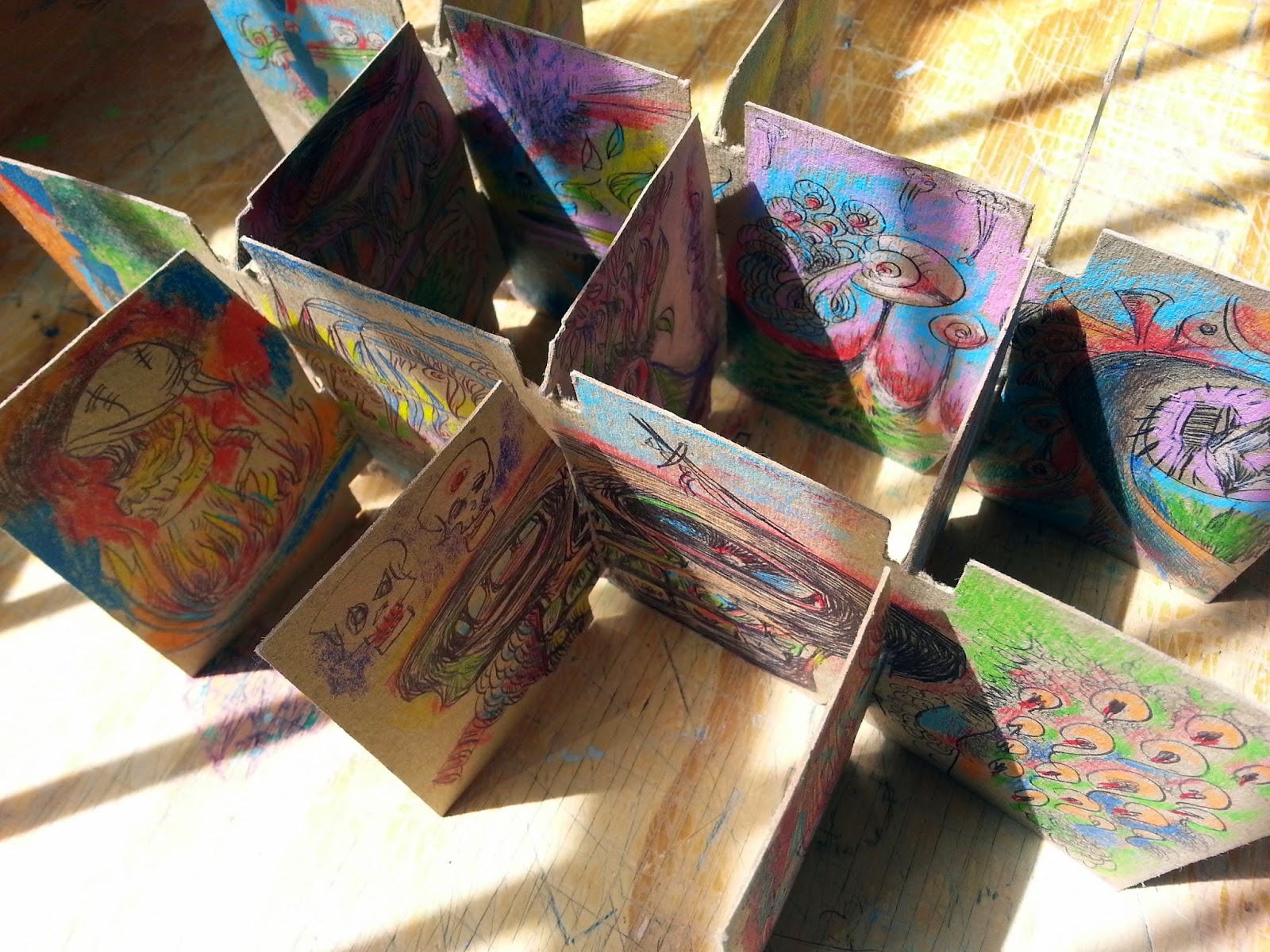
Bagatela
A collaboration with Marco Patiño, Pachuca, Mexico.
Conversation, sharing ideas, beers, and more ideas.
Ballpoint, jell pen, and crayons on beer bottle separators.



Sunday, October 26, 2014
Venantius** “vouging” Kanji characters
मार दो हथौड़ा
Stokes as sweeps, slashes, and flicks
rendered as metaphors, imbued in our minds,
into muscular memory, sense, sensibility,
facility, and conviction.applied, expressed,
and impressed on paper, silk, wood. As also on bodies.
facility, and conviction.applied, expressed,
and impressed on paper, silk, wood. As also on bodies.
Steatite, clay, wood, rubber stamped—within minds and the sands of time
The word initiated our corporeality and continues shaping us.
Bringing to us the Eijihappo.
Bringing to us the Eijihappo.
The Eight principles have reached us under considerable influence
via the Seven Powers by Lady Wei Shuo of Eastern Jin.
Madame Wei, or as she was know Maoyi—made it her focus
despite Uncle Wei Heng’s objections to study Shufa;
when it was not considered a female virtue.
Assisting at grinding ink at the inkstone, watching and absorbing
the movement in the characters—practicing discretely in her room.
Upon seeing her work one day Uncle Heng so as to,
“not foil her aspirations” graciously stepped back.
Upon seeing a stone falling; Maoyi desired to capture its thrust!
Drawing inspiration from the spirit of matter and materiality.
Influenced she is said to have Wang Xizhi’s running style.
The principles received praise from Li Zongyuan of the Tang;
Unique metaphors created by Li Puyang of the Yuan.
That stone falling sideways
Spawning a seeing of dots, thrusts of our personhood!
Adumbrations, mysteries of what is contained within.
Regard the O-hou, the Cho-hou, and Gan-pou
manners that will define your will if you so will
Ancestors, Rinsho practice, and Providence belittle not.
a jade case, abuts an an iron pillar,
from whose base be prepared to summon
that jump: grace which only you can summon as your own
from whose base be prepared to summon
that jump: grace which only you can summon as your own
an elemental argument with your mortality
pulling away from gravity—weightless,
coalescing into the next movement
a crabs claw, the hook! Raise and lash the horsewhip
a tigers fang, slashes new meaning to your personhood
unbounded through sweeps, slashes, and strokes of light movement.
Be, bringing fluidity to thy being. Incorporate the curve of a rhinoceros’ horn.
unbounded through sweeps, slashes, and strokes of light movement.
Be, bringing fluidity to thy being. Incorporate the curve of a rhinoceros’ horn.
Unite with your fellows in Saado, Kado and Kodo.
Nuances, compressed movements; open up the universe
Aikido, Iaido, and Shodo,
Kyudo, the way of Archery
Kyudo, the way of Archery
Stroke, one flowing into the other.
Seeking our mark—towards eternity from our temporality!
At the swayamvara in Panchala dressed as a Brahmin,
Arjuna stands; taking a moment to focus on the piscean image
set on high, atop a rotating wheel, and reflecting in the pool at his feet.
The arrow pierces. The discerning Pandavas…take to heart,
and hearth—Draupadi: Panchali, Mahabhaaratii, Sairandhri, Yajnaseni, Agnijyotsna.
Kṛṣṇə Draupadī, A son with each of the Pandavas—
with the eldest Yudhishthira begat she Prativindhya.
Likewise Sutasoma from Bheema, Srutakirti from Arjuna,
Satanika from Nakula, and Srutakarma from Sahadeva
There are laws and there are boons. Shivan no less.
Understandably, no Eijihappo for them as for the Tamilians…
There are ways and ways, and Ways of ways.
Karikala Chola to Athirajendra. Chola’ all. But philosophies similar…
and rigorous. Kalaripayattu. Dandpattas. and wagh nakkas.
Tanaji climbed Singhagad’s crags aided by the monitor…lizard.
Seek to discern, the tools you shall keep receiving.
The brush was flung. Kobo Daishi made the mark.
Distance must not awe. Its a journey, and remember,
that your tools may be usurped from you.
Eklavya the archer, gave up his thumb, so willed
Dronacharya his guru to maintain the status quo!
Remembering Ki no Tsurayuki from the Hyakunin Isshu…
The depths of the hearts (Hito was isa)
Of humankind cannot be known. (Kokoro mo shirazu)
But in my birthplace (Furusato wa)
The plum blossoms smell the same (Hana zo mukashi no)
As in the years gone by. (Ka ni nioi keru)
Damayanti of Vidarbha, and Nala. Heera and Ranjha.
Laila and Majnu. Lines and movement in the mind of time.
Abelhard and Heloise. Narcissus and Goldmund—
A wandering towards “a meaning of life.” A Way.
Rani of Jhansi, son strapped to her spine, wades into mayhem—
battling obfuscation by the English…flurry of words. Centered.
Karna looked at the Sun and howled spasms of righteous wrath
Bypass we must those who toil attempting foiling ones path.
Dash through heath and scar. Mark the forehead.
A bird pecking—seeking,
a dismemberment for real on paper
and more so when blood was spilt
Now it remains in metaphor as a wave,
pressure exerted with focus and we have
The golden sword that unders, dissects, and rends minds
and minds.
and minds.
Dividing space, yet holding it together
Dissection. More meat on bones or more as Lady Wei
Dissection. More meat on bones or more as Lady Wei
unified yet distinct. Tremors.
Movement becomes us,
we imbue it, it extends us,
Radiating minds; extending our being
outside of our temporality the surround.
See the Eiji Happo,
Rewrite:
The Eight Principles of Yong (Chinese: 永字八法; pinyin
Eight Principles of The Character “永 (えい, ei, i.e “eternity”)”; (永字八法, えいじ はっぽうeiji happō)
This calligraphic theory, set forth by a Sui dynasty (隋朝, pinyin: Suí cháo, 581 – 618 C.E.) calligrapher named Zhi Yong (智永, pinyin: Zhì Yǒng, birth and death dates unknown), defines eight out of a total of 37 basic strokes of the standard script (楷書, かいしょ, kaisho). These are:
1. 側 (そく, soku) lit. “vicinity”. It is also referred to as 点 (てん, ten) – “a dot”, or 怪石 (かいせき, kaiseki) – “oddly shaped stone” (from its appearance of a rounded rock).
2. 勒 (ろく, roku)”a halter”, also referred to as “jade table” (玉案, ぎょくずき, gyokuzuki) of smooth and even surface.
3. 努 (ど, do)means “to exert”. This vertical stroke is also known as 鉄柱 (てっちゅう, tetchū) – “iron pole”, from its solid and rigid appearance.
4. 趯 (てき, teki)suggests “lifting”, or “a hook”, also referred to as 蟹爪 (かいそう, kaisō, i.e. “crab pincer”).
5. 策 (さく, saku, i.e. “a horsewhip”), or虎牙 (こが, koga, i.e. “tiger fang”).
6. 掠 (りゃく, ryaku). One of the meanings is ‘to graze”, like the non-lethal cut of an expert swordsman. Another name for this stroke is 犀角 (さいかく, saikaku, i.e. “rhinoceros horn”).
7. 啄 (たく, taku, i.e. “a peck”)or “bird’s peck” (鳥啄, ちょうたく, chōtaku).
8. 磔 (たく, taku, i.e. “dismemberment”), also known as 金刀 (きんとう, kintō, i.e. “golden Dao sword”).
More detailed information regarding standard script is to be found here.
側 soku :: dot, (Japanese) ten
勒 roku :: horizontal stroke, yokoga
努 do :: vertical stroke, tatega
趯 teki :: upward flick from a vertical or horizontal stroke,** hane
** diagonal flick from the point where a stoke culminates
策 saku :: upward right flick, migihane
掠 taku leftward downstroke :: hidaribarai
啄 taku leftward downflick :: hidarihane
磔 taku rightward downstroke :: migibarai
怪石, 玉案, (鐵柱/铁柱), 蟹爪, 虎牙, 犀角, (
Guài shí, Yù àn, (Tiě zhù/tiě zhù), Xiè zhuǎ, Hǔyá, Xījiǎo, (Niǎo zhuó)/(niǎo zhuó), Jīn dāo
Mysterious/strange rock/stone, Jade Case/table, iron posts, Crab piner, Tigers tooth, Rhino horn, (Bird pecking) / (Bird pecking), Golden sword
Subscribe to:
Posts (Atom)