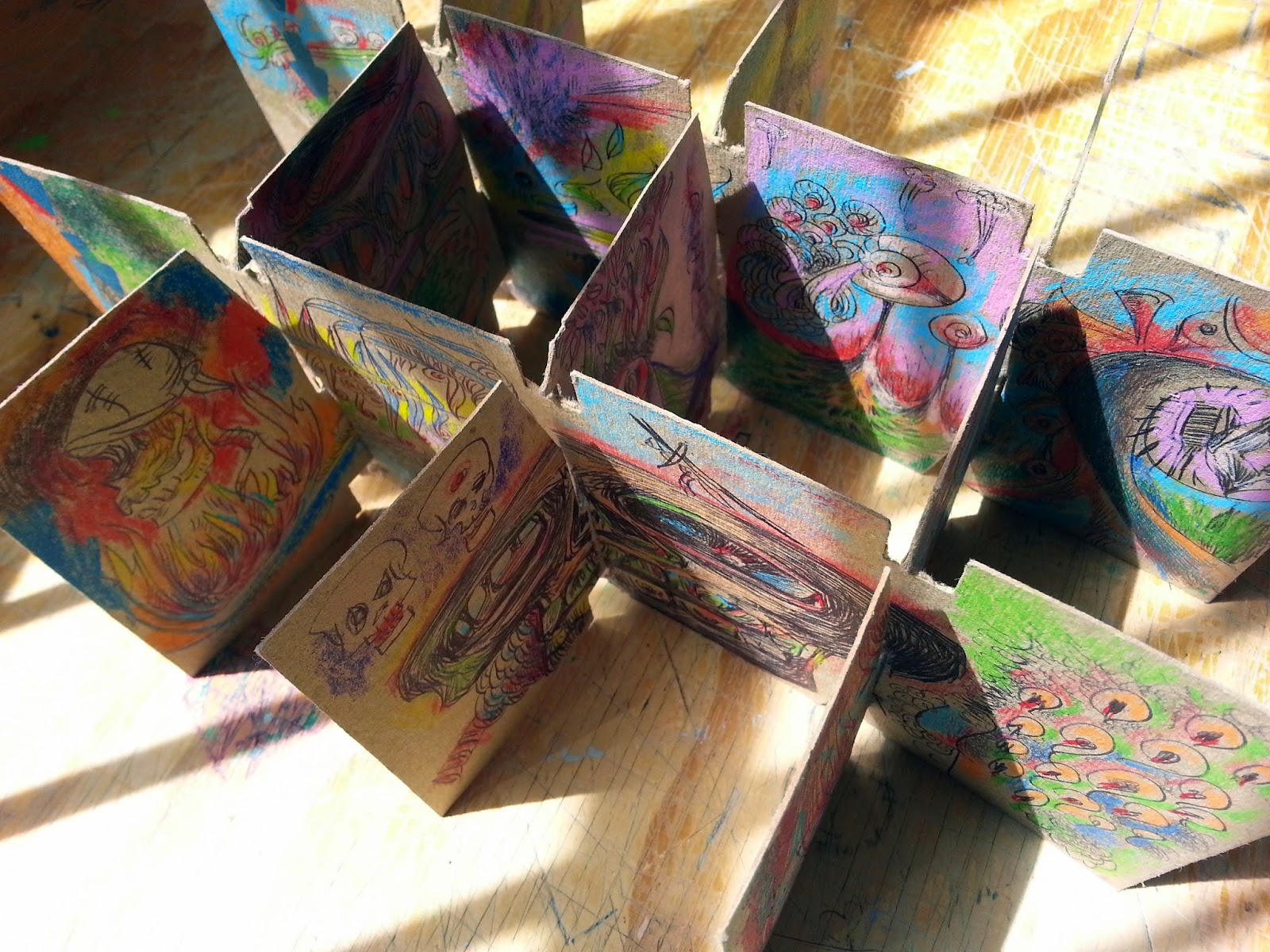
मार दो हथौड़ा
Stokes as sweeps, slashes, and flicks
rendered as metaphors, imbued in our minds,
into muscular memory, sense, sensibility,
facility, and conviction.applied, expressed,
and impressed on paper, silk, wood. As also on bodies.
Steatite, clay, wood, rubber stamped—within minds and the sands of time
The word initiated our corporeality and continues shaping us.
Bringing to us the Eijihappo.
The Eight principles have reached us under considerable influence
via the Seven Powers by Lady Wei Shuo of Eastern Jin.
Madame Wei, or as she was know Maoyi—made it her focus
despite Uncle Wei Heng’s objections to study Shufa;
when it was not considered a female virtue.
Assisting at grinding ink at the inkstone, watching and absorbing
the movement in the characters—practicing discretely in her room.
Upon seeing her work one day Uncle Heng so as to,
“not foil her aspirations” graciously stepped back.
Upon seeing a stone falling; Maoyi desired to capture its thrust!
Drawing inspiration from the spirit of matter and materiality.
Influenced she is said to have Wang Xizhi’s running style.
The principles received praise from Li Zongyuan of the Tang;
Unique metaphors created by Li Puyang of the Yuan.
That stone falling sideways
Spawning a seeing of dots, thrusts of our personhood!
Adumbrations, mysteries of what is contained within.
Regard the O-hou, the Cho-hou, and Gan-pou
manners that will define your will if you so will
Ancestors, Rinsho practice, and Providence belittle not.
a jade case, abuts an an iron pillar,
from whose base be prepared to summon
that jump: grace which only you can summon as your own
an elemental argument with your mortality
pulling away from gravity—weightless,
coalescing into the next movement
a crabs claw, the hook! Raise and lash the horsewhip
a tigers fang, slashes new meaning to your personhood
unbounded through sweeps, slashes, and strokes of light movement.
Be, bringing fluidity to thy being. Incorporate the curve of a rhinoceros’ horn.
Unite with your fellows in Saado, Kado and Kodo.
Nuances, compressed movements; open up the universe
Aikido, Iaido, and Shodo,
Kyudo, the way of Archery
Stroke, one flowing into the other.
Seeking our mark—towards eternity from our temporality!
At the swayamvara in Panchala dressed as a Brahmin,
Arjuna stands; taking a moment to focus on the piscean image
set on high, atop a rotating wheel, and reflecting in the pool at his feet.
The arrow pierces. The discerning Pandavas…take to heart,
and hearth—Draupadi: Panchali, Mahabhaaratii, Sairandhri, Yajnaseni, Agnijyotsna.
Kṛṣṇə Draupadī, A son with each of the Pandavas—
with the eldest Yudhishthira begat she Prativindhya.
Likewise Sutasoma from Bheema, Srutakirti from Arjuna,
Satanika from Nakula, and Srutakarma from Sahadeva
There are laws and there are boons. Shivan no less.
Understandably, no Eijihappo for them as for the Tamilians…
There are ways and ways, and Ways of ways.
Karikala Chola to Athirajendra. Chola’ all. But philosophies similar…
and rigorous. Kalaripayattu. Dandpattas. and wagh nakkas.
Tanaji climbed Singhagad’s crags aided by the monitor…lizard.
Seek to discern, the tools you shall keep receiving.
The brush was flung. Kobo Daishi made the mark.
Distance must not awe. Its a journey, and remember,
that your tools may be usurped from you.
Eklavya the archer, gave up his thumb, so willed
Dronacharya his guru to maintain the status quo!
Remembering Ki no Tsurayuki from the Hyakunin Isshu…
The depths of the hearts (Hito was isa)
Of humankind cannot be known. (Kokoro mo shirazu)
But in my birthplace (Furusato wa)
The plum blossoms smell the same (Hana zo mukashi no)
As in the years gone by. (Ka ni nioi keru)
Damayanti of Vidarbha, and Nala. Heera and Ranjha.
Laila and Majnu. Lines and movement in the mind of time.
Abelhard and Heloise. Narcissus and Goldmund—
A wandering towards “a meaning of life.” A Way.
Rani of Jhansi, son strapped to her spine, wades into mayhem—
battling obfuscation by the English…flurry of words. Centered.
Karna looked at the Sun and howled spasms of righteous wrath
Bypass we must those who toil attempting foiling ones path.
Dash through heath and scar. Mark the forehead.
A bird pecking—seeking,
a dismemberment for real on paper
and more so when blood was spilt
Now it remains in metaphor as a wave,
pressure exerted with focus and we have
The golden sword that unders, dissects, and rends minds
and minds.
Dividing space, yet holding it together
Dissection. More meat on bones or more as Lady Wei
unified yet distinct. Tremors.
Movement becomes us,
we imbue it, it extends us,
Radiating minds; extending our being
outside of our temporality the surround.
See the Eiji Happo,
Rewrite:
The Eight Principles of Yong (Chinese: 永字八法; pinyin: Yǒngzì Bā Fǎ; Japanese: 永字八法/えいじはっぽう,eiji happō; Korean: 영자팔법, Yeongjapalbeop; Vietnamese: Vĩnh Tự Bát Pháp/Tám Phương Pháp viết Chữ Vĩnh) explain how to write eight common strokes in regular script which are found all in the one character, 永(pinyin: yǒng, "forever", "permanence"). It was traditionally believed that the frequent practice of these principles as a beginning calligrapher could ensure beauty in one's writing.
Eight Principles of The Character “永 (えい, ei, i.e “eternity”)”; (永字八法, えいじ はっぽうeiji happō)
This calligraphic theory, set forth by a Sui dynasty (隋朝, pinyin: Suí cháo, 581 – 618 C.E.) calligrapher named Zhi Yong (智永, pinyin: Zhì Yǒng, birth and death dates unknown), defines eight out of a total of 37 basic strokes of the standard script (楷書, かいしょ, kaisho). These are:
1. 側 (そく, soku) lit. “vicinity”. It is also referred to as 点 (てん, ten) – “a dot”, or 怪石 (かいせき, kaiseki) – “oddly shaped stone” (from its appearance of a rounded rock).
2. 勒 (ろく, roku)”a halter”, also referred to as “jade table” (玉案, ぎょくずき, gyokuzuki) of smooth and even surface.
3. 努 (ど, do)means “to exert”. This vertical stroke is also known as 鉄柱 (てっちゅう, tetchū) – “iron pole”, from its solid and rigid appearance.
4. 趯 (てき, teki)suggests “lifting”, or “a hook”, also referred to as 蟹爪 (かいそう, kaisō, i.e. “crab pincer”).
5. 策 (さく, saku, i.e. “a horsewhip”), or虎牙 (こが, koga, i.e. “tiger fang”).
6. 掠 (りゃく, ryaku). One of the meanings is ‘to graze”, like the non-lethal cut of an expert swordsman. Another name for this stroke is 犀角 (さいかく, saikaku, i.e. “rhinoceros horn”).
7. 啄 (たく, taku, i.e. “a peck”)or “bird’s peck” (鳥啄, ちょうたく, chōtaku).
8. 磔 (たく, taku, i.e. “dismemberment”), also known as 金刀 (きんとう, kintō, i.e. “golden Dao sword”).
More detailed information regarding standard script is to be found here.
側 soku :: dot, (Japanese) ten
勒 roku :: horizontal stroke, yokoga
努 do :: vertical stroke, tatega
趯 teki :: upward flick from a vertical or horizontal stroke,** hane
** diagonal flick from the point where a stoke culminates
策 saku :: upward right flick, migihane
掠 taku leftward downstroke :: hidaribarai
啄 taku leftward downflick :: hidarihane
磔 taku rightward downstroke :: migibarai
怪石, 玉案, (鐵柱/铁柱), 蟹爪, 虎牙, 犀角, (鳥啄)/(鸟啄), 金刀
Guài shí, Yù àn, (Tiě zhù/tiě zhù), Xiè zhuǎ, Hǔyá, Xījiǎo, (Niǎo zhuó)/(niǎo zhuó), Jīn dāo
Mysterious/strange rock/stone, Jade Case/table, iron posts, Crab piner, Tigers tooth, Rhino horn, (Bird pecking) / (Bird pecking), Golden sword