Friday, March 7, 2014

In, An Illustrated Life. Danny Gregory. 2008.


An Illustrated Life Drawing inspiration from the private sketchbooks of artists, illustrators and designers, by Danny Gregory. 2008.
http://parkablogs.com/content/illustrated-life-venantius-j-pinto

Contents:
Illustrated lives: an introduction, Mattias Adolfsson, Peter Arkle, Rick Beerhorst, Butch Belair, France Belleville, Bill Brown, Simonetta Capecchi, Robert Crumb, Peter Cusack, Penelope Dullaghan, Mark Fisher, Enrique Flores, Paola Gaviria, Barry Gott, Seamus Heffernan, Kurt Hollomon, Christine Castro Hughes, Rama Hughes, James Jean, Cathy Johnson, Noah Z. Jones, Tom Kane, Amanda Kavanagh, Don Kilpatrick, James Kochalka, Gay Kraeger, Jane Lafazio, Christina Lopp, Paul Madonna, Hal Mayforth, Adam Mccauley, Prashant Miranda, Christoph Mueller, Brody Neuenschwander, Christoph Neimann, Marilyn Patrizio, Everett Peck, Venantius J. Pinto, Edel Rodriguez, Trevor Romain, Stefan Sagmeister, Christian Slade, Elwood Smith, Paul Soupiset, Roz Stendahl, Chris Ware, Melanie Wilson, Cindy Woods, Bryce Wymer, Acknowledgments.


Venantius grew up in Bombay, India. He studied advertising, design and illustration at the Sir J.J. Institute of Applied Art, then communication design and computer graphics at Pratt Institute in New York. He now works  a digital artist. His work can be seen at www.flickr.com/photos.venantius/sets

The purpose is indeed to depict the metaphor that resides fleetingly in my mind’s eye. My books give clarity to the thoughts that come to me. I believe we do not come by our thoughts, they come to us. 

The books are documents of understanding and resolution, or MOUs (memoranda of understanding) with myself if you will. They are a budo, a way of life. “Illustrating Understanding,” or “Illustrating to Reveal” would be more my cup of thought. In a sense they are an art form unto themselves and are indeed stand alones. I am not averse to incorporating aspects into other works, thought that has not happened as yet. They are trenches of visual thinking where one works out process and emotions, and learns to overcome fear.


The nature of my drawing is not about documenting the day-to-day. It’s about helping me understand ideas that come to me, and drawing is a vehicle to help me register my absorption of those thoughts. I attempt to understand what it is that moved me. “We do not come by our thoughts, they come to us” is something I deeply believe in. This is very significant to the way we understand things. 

My first and only rule, or obsession, is rigor. So the work must have a place, a reason it was attempted and for which it will be finished—to contribute significantly to the discourse on analysis, form, color, technique and so on. That is all I care about. I am not interested in effects or fancy manipulation. Having said that, I must add that I am abundantly blessed and have refined my techniques.

A book functions as a repository of the mind, a compact, portable, narrative mural. One moves to the next page only after being satiated with the current one. One carries and adds to the understanding gained from page to page. The sharing commences from something being stirred, and then the feeling dissipates, at which point enough has been revealed. 


I am in the process of making a set of three large books, and I like the idea that a book can be closed after it has been shared. To me, drawing on loose sheets of paper does not have the togetherness of a book. I would prefer to keep even a loose set of drawings in a box. But scraps of paper have their own dynamic, particularly those that do not conform to logical shapes.

The consistent thread in my work has always been the pursuit of thought. Everything else shifts. There is a certain line quality that is consistent, but I must say that too is subservient to the idea at hand. Nothing subordinates the idea and the understanding of it. 

This is my second phase in my sketching, with a lull in between of almost fifteen years, during which I only did thumbnails. I began sketching when I was in the seventh grade but have nothing to show for it. My second phase began in 2001, and I have a ton of work since then. I am very happy with the way things turned out. The subjects that I work on are complex and have required me to impart a high degree of skill and technique to realize them. I will soon be working on long scrolls. There have been short periods when I stopped drawings in order to spend time thinking without paper and marking tools. 

I drew as a child, beginning around age three. My first drawing was on the threshold of our company apartment in Mumbai, India. My entire lived movement is based on line. I would be egotistical in saying that every move of mine is akin to drawing, Lines move me, and a hurried line kills me. 
 
I prefer accordion books. I also like books that are tightly bound and ring bound books from Maruzen. I buy the accordion books in Japan and at Kinokuniya on Forty-ninth Street and Soho Art Materials on Grand Street, New York (Kinokuniya is now at 1073 Ave. of the Americas; and Soho Art Materials moved to 7 Wooster Street). Other types of books I buy at Pearl Paint and at New York Central. I have bought books in Lahti (Finland), India, Berlin, Mexico, etI draw with ballpoint (biro), pen and ink, silverpoint, pencils, various inks (including walnut and sumi), var. watercolors (including Gansai), goldleaf, gouache, fingers, etc. 

I use cases to store the books. It’s a pretty impressive  experience when Customs in various countries have asked me to open my case(s). I had a Swiss border policeman ask for prices. I was traveling via train from Cremona (Italy) to Stockholm. In Stockholm, airport security asked me to open my case, and it was a sight to witness the awestruck smile of the agent, who I am sure, was of Sri Lankan origin. The others had stopped what they were doing to watch! I think they regarded this as something special—a cargo that had to be with me.  
 
When I look back through my books, frankly speaking, its hard to believe I did them. I keep certain books together, my script drawing books for instance. I also always have one book that is close to me, one that I may occasionally skim trough to take in the detail. It’s revealing how much I learn about possibilities, which in turn strengthen my resolve to keep moving towards more intriguing directions. I recently reviewed some of my books and could not understand the automatic-ism in the drawings. It’s almost as if despite all my thinking, something else has interjected itself, which made the work into a collaboration. Perhaps collaboration with the limbic region, that mysterious space to which some people attribute divine connotations. 

I have often suggested to people how a book may be approached: the nature of narrative structure. The significance of maintaining a meta-narrative through all the smaller narratives that make up our own narratology, an internal geography. How do we gain, aside from the nature of the gain, by seeing and observing the outside? Draw to understand yourself. —Venantius J Pinto 


Sunday, March 2, 2014

In, CROP CIRCLES: An Art of our Times by Mary Carroll Nelson, 2007.


Agrometry 1. 2000. Seen at the Internatiaonal Print Center, New York City. Roland Print on Concorde Neutral White. Print size: 24" x 34", Image size: 16.3" x24.2". 

Edition: 20+2AP Printed by: Xian Chen


Venantius Joseph Pinto, a resident of New York City, has had a multidimensional perspective for most  of his life. The eldest of three sons, he was raised in Bombay, India,  in a Christian family originally Goans. The former Portuguese colony was liberated and became part of India the year Pinto was born, 1961. Goans Christians are a minority in Bombay, but Pinto says when he was growing up, “I saw myself as different rather than separate.”
Pinto completed six years of study in Bombay at the J.J. Institute of Applied Art, earning his degree in Applied Art before coming to the United States in 1987. In 1991, he graduated from Pratt Institute in Brooklyn, NY with a Master of Fine Arts degree in Computer Graphics.

Pinto’s solid background in design and technique of applied art became the foundation for his work. He incorporated his art education from India with the potential of digital art and came up with a unique process. “I’d do things in a traditional medium; then at night I’d go to the lab and replicate them through the computer.”

Pinto’s work includes a wide range of mediums, from detailed tempera illustrations reminiscent of historic Indian miniatures to abstractions, layered in glimmering veils of digital color. He has established a network of connections in the tough, fast-paced business of graphic art. At the same time he is devoted to the reflective, philosophical intimacies of his studio. Wherever he goes, he maintains simultaneously the objectivity of a stranger and the passionate commitment to membership in the boundless world of art.

Venantius Pinto seems to live between dimensions, always aware of more than one meaning to the events of his life. He is and will remain a man of India, versed in her myths and iconography. As a Catholic, he has integrated within himself the heritage of  Western Europe. As an artist he looks for content, relatedness, and genuine expression.

“The first thing I felt when I saw the crop circles was that there is some kind of consciousness inherent in them, an intelligence, a mystery, a humor that is giggling at us. Even if they are made by hoaxers, i’m still seeing a talent and consciousness that is coming through them.”

Sita under the full moon. Mixed Media Print size: 11.5" x 15", Image size: 9" x 11.75". 1998. Edition: Unique. 

Printed by: Vijay Kumar
“The geometry is fascinating, especially in the fields. They could have happened in the moors. I ask myself, why are the fields used as a ritual landscape? And I am reminded of Sita, ancient Hindu goddess in the fields, whose independent goddesshood was robbed by the orthodoxy by coupling her with the more contemporary god Rama.”

“I think where the crop circles are  is as important as what they are. The English fields are so ordered. Where a crop circle appears, it is as though a big hand has embossed them.”

“The crop circle is technique on a huge scale. It is very specific. A lot of time has been spent on thinking it out. It forces us to think, too. I see digital artists using techniques inappropriate to the tool and medium, whereas crop circle artists have invented a technique exactly suited to its site and material.”


Agrometry 2. 2000 appears in Crop Circles: An Art of Our Times. Roland Print on Concorde Neutral White. Print size: 24" x 34", Image size: 16.3" x 24.2". Edition: 20+2AP Printed by: Xian Chen

One of Pinto’s series of digital prints features crop circles. The shimmering Agrometry 2 is from this series; it (correction: it was Agrometry 1, which) was shown at the International Print Center in New York City (in Winter 2001). 

Sunday, February 23, 2014

Taking names

The bestowing of a name is reason of great significance since it is carried to ones grave unless of course it is waylaid, frittered or render meaningless to ones sense of being. My mother Otilia named me after St. Venantius whose name she came across in a calendar published by the Salesians of Don Bosco, Matunga Mumbai. My father Bernard and she were pleased with the name, not knowing anything more than that Venantius (of Camerino) was a martyr born on May 18. Later I heard of Venantius Honorius Clementianus Fortunatus, Latin poet and hymnodist, venerated during the Middle Ages as Saint Venantius Fortunatus. In late 2012 while perusing a dictionary of saints at the Pauline Book Store on 38th Street, I learnt that there were six saints by that name! Venny, was the diminutive coined by my mother, and as a child I was called Vennysan, and not at all intended to mimic the Japanese honorific –san. She knew very, very little English, but apparently her use of the word san was a cognate with the English son, inflected from a sound palette rooted in my mother tongue Konkani/Konknni, in which I would have been addressed as Venny baba (son) or Baba Venantius. Furthermore I was also called Bab/a Venaçio in letters to my mother from family in Goa, in essence living at a meshing of two languages Konkani and Portuguese. A threshold so. 

BABY PIC 

Up until early adulthood, I was addressed as Venny only by family. It was only much later in New York that I realized that Venantius did not seem to sit well with most South Asians, in that they could not be bothered to voice it. One does not endear oneself by deciding to call you by the name that only a few may. Its about taking shortcuts and not meriting that embrace. In fact most of them had more than a decent grip of English, and included assorted graduate students, activists, and of course professors. I believe it was easier for these to get themselves to pronounce Csikszentmihalyi rather than hear themselves say Ve+nan+tius (shius, or tius). Go figure that out. Finding flow is not easy if one does not wish to live it on an ongoing basis! Looking back I now see that there was something terribly lazy about them. So Venny made it to the out groups (haha) and Venantius ensconced from their sorry ambits. What was worse was being addressed in shrill tones as Vinny by those of the same elan. Shudder. I had no intentions of being the Pooh at their march into the Postmodern. 

JJ PICs

During my years at Art School it was Pinto, barring the Christians, and some others. Then there was also Venya, and Venni (braided hair). The latter two were spontaneously assigned names rooted in Marathi phonetics. Reflecting back, if I was a warrior with the Marathas—I can imagine being called so. The former, my surname was just the way one was usually addressed, although not always so as clarified. 

Back in others I believe Venantius was a cheesecake of a name replete with the extra calories. Of course we all travel a long way from the onset of our professional education, its continuation to the points where we do not look askance at Solzhenitsyn. Its about seeking a harmony of hearing, of listening.  

And then there were those who simply aped. If Baida (Egg) calls you Venny, I Vidwaan (Scholar) too can. All fine na? Na? 

ベナンシャス, べなんしゃす:
When I first began to study Shodo, more precisely Shuji my teacher transliterated Venantius into Benansyasu as opposed to say even Venansyasu. It felt strange at first but I accepted being confined within Japanese phonetics although being aware that when Japanese children began excelling at the violin, the earlier bayorin was dropped in favor of violin. The same happened with many other words. There is nothing that prevents the Japanese from saying Venantius or as in cases where words begin in V, or L, or for that matter in Latin if they wish to—with a tiny bit of effort. That effort being a broadening of the consonant palette.

Rinsho chop, VJP image 

修験海: 
Later when my Rinsho studies began I took the opportunity to take on a nom de plume (go) and upon much though settled on ShuGenKai. Sensei was taken aback, perhaps since it had three-characters. She consulted with Nihon Shuji in Tokyo whose response was indeed positive —admirable in fact. So, I got to keep the name, and it was the first time I had not budged. Many particularly in the West have their own sense of respect to their teaches, or guides. I am not exactly a child, an as with natures I have stopped diluting mine.

As time passed — through reading, belief, and practice, I began getting and developing a sense of Shodo, and of Shuji and Tenarai. 

The names added and it was all not so fragmented as it may appear.  

s: ベナンシャス、べなんしゃす, 修験海、静風、辺南、一登 
(Benansyasu, ShuGenKai, SeiFu, BenNan, PinTou)

Benansyasu, ベナンシャス, べなんしゃす
My regular name since I began my studies and written in Katakana, and sometimes in Hiragana. 

ShuGenKai, 修験海: The asectics sea. I use this name for Rinsho. 

SeiFu, 静風: Static wind. Imagine a wind which is still/calm, but still a wind. Sensei gave me this name. 

BenNan, 辺南: Ben from Benkyou (Studies), and Nan means South, I use this name for Kana.

PinTou, 一登: Pintou means focus, and is a sound cognate of my surname Pinto. This is my signature for painting, at this point Boku-ga, Sumi-e, and Suisai-ga. 


Saturday, February 22, 2014

From a long essay in progress, Taking Names

Caetano Xavier Figueiredo and 
Venançio José Pinto e Figueiredo, Batim Goa 


The bestowing of a name is a reason of great significance since, it is carried to ones grave unless of course it is waylaid, frittered or render meaningless to ones sense of being. My mother Otilia named me after St. Venantius whose name she came across in a calendar published by the Salesians of Don Bosco, Matunga Mumbai. My father Bernard and she were pleased with the name, not knowing anything more than that Venantius (of Camerino) was a martyr born on May 18. Later I heard of Venantius Honorius Clementianus Fortunatus, Latin poet and hymnodist, venerated during the Middle Ages as Saint Venantius Fortunatus. In late 2012 while perusing a dictionary of saints at the Pauline Book Store on 38th Street, I learnt that there were six saints by that name! Venny, was the diminutive coined by my mother, and as a child I was called Vennysan, and not at all intended to mimic the Japanese honorific –san. She knew very, very little English, but apparently her use of the word san was a cognate with the English son, inflected from a sound palette rooted in my mother tongue Konkani/Konknni, in which I would have been addressed as Venny baba (son) or Baba Venantius. Furthermore I was also called Bab/a Venaçio in letters to my mother from family in Goa, in essence living at a meshing of two languages Konkani and Portuguese. A threshold so to speak which I hope to explore in the near future. 

Up until early adulthood, I was addressed as Venny only by family. It was only much later in New York that I realized that Venantius did not seem to sit well with many South Asians. in that, they could not be bothered to voice it. One does not endear oneself by deciding to call you by the name just cause you pal does. Maybe you do not know the relationships we have formed. Its about taking shortcuts and not meriting that embrace. In fact most of them had more than a decent grip of English, and included assorted graduate students, activists, and of course professors. I believe it was easier for these to get themselves to pronounce Csikszentmihalyi rather than hear themselves say Ve+nan+tius (shius, or tius). Go figure that out. Finding flow is not easy if one does not wish to live it on an ongoing basis! Looking back I now see that there was something terribly lazy about them. So Venny made it to the out groups (haha) and Venantius ensconced from their sorry ambits. What was worse was being addressed in shrill tones as Vinny by those of the same elan. Shudder. I had no intentions of being the Pooh at their march into the Postmodern.

(This essay will talk about all my other names by way of Shodo, Bokuga, Tenkoku…)

Friday, February 21, 2014

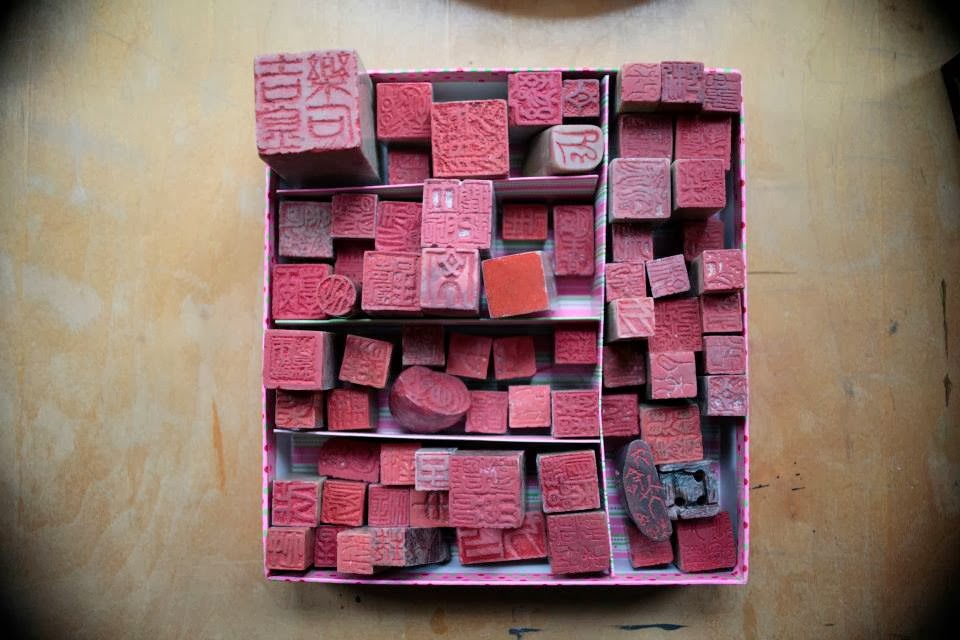
Short clip of 一登 PinTou beginning to carve a chop


A short clip of me carving again after a fourteen month break, aside from putting in a few hours about two months ago. Interesting to watch oneself…I look pretty calm now! Hoping to get back to my regular pace sometime soon. Pray for me please. Btw, my fingers are not broken. :) Thanks.

Thursday, January 9, 2014

One angle on Charity


Quarter kilo of dry bhel shared in true Lokshahi (democratic) fashion.


“As the Vatican Almoner, Archbishop Konrad Krajewski explained, charity has to cost you something so it can change you. The Archbishop shared the story of a fellow clergyman who boasted of giving a few euros to a homeless man outside the Vatican, and explained how in spite of the gift, it wasn't genuine charity because the euros cost the cleric relatively nothing.” 
The intent, and practice of charity if we let it will suffuse many aspects of our lives, including through the sharing of knowledge. But, if there is hardly an element of risk, or no costs involved in that act, in the transaction—then there is nothing to it. It is in the giving that we receive, or shall we say we become whole at that moment, and this is but one interstice in the continuum of our being and personhood. But we hardly engage, we avoid risks—being too frightened to contemplate, of course taking into consideration the contexts involved, that our rightful place may truly be at the back of the line. It is better to stay where we belong, instead of making every covert yet aggressive attempt that we belong further along in what we do. Otherwise all that babble about Karma is a mere indulgence. These thoughts came to mind upon being faced with Archbishop Konrad Krajewski’s concise simplification of charity; having indeed encountered it on my journey.


Say it already


आमची सौन्स्क्रुति पांच हज़ार वर्षींची, आमचा मार्ग सुद्धा जवळपास तेवड़ा व् जस्ता पण हे घोस्टय कोचित दिसून येतात। 

 संदीप्रकासाचे सामुराई . गोधूलि। सांझ के समुराई

Say, say say what you wanna 

Gainsay 

Naysay 

Assay 

Daresay 

Soothsay 

Hearsay